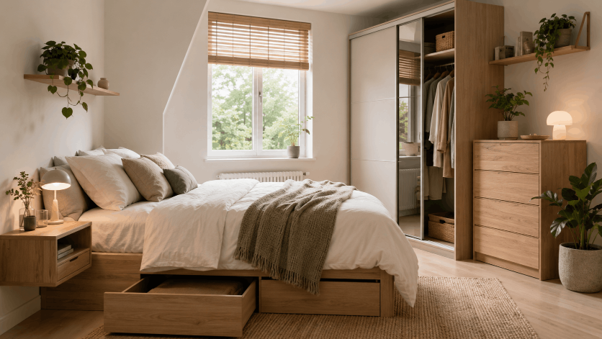
UK bedrooms have been getting smaller for years. Housing data shows the average bedroom shrank from around 165 square feet in the 1930s to about 141 square feet in many modern new-builds. So if your room feels tight, you're not alone. Most of us are working with less space than our grandparents had.
The good news? A few smart choices can make a compact room feel open and restful. This guide walks through the furniture that works best, piece by piece, plus how to plan the room so it all fits.
Measure your room before you buy anything
Before you spend a penny, grab a tape measure. This one step saves you from costly mistakes. Measure twice, buy once.
Write down the length and width of each wall. Note where the door swings open, where the window sits, and how much room the radiator takes. Then sketch a simple plan on paper, or use a free online room planner. Shift the furniture around on the page first. It's far easier than dragging a real chest across the floor and finding it blocks the door.
It also helps to know what counts as "small." In the UK, a room under 4.64 square metres can't legally be called a bedroom at all. Most single rooms sit around 7 to 9 square metres, and doubles around 11 to 14. If yours is near the lower end, plan for fewer, slimmer pieces from the start.
One more habit worth having: think in zones. Even a tiny room has a sleep zone (the bed), a storage zone (drawers or a wardrobe), and sometimes a work or dressing zone. Give each job a clear spot and the room feels sorted, not squeezed.
Start with the bed

The bed is the star of the show. It's the biggest thing in the room, so it sets the mood for everything else. Get this one right and the rest is easier.
For small rooms, go low and simple. A platform bed with clean lines and slim sides keeps things light. A tall or bulky frame does the opposite. It eats the space and makes the walls feel closer. Skip the footboard if you can. Without it, you can walk around the bed more easily, and your eye travels across the floor instead of stopping short.
Pick the right bed size
Bed size matters as much as bed style. Here's a rough guide for small UK rooms:
-
Single (90cm wide) - best for box rooms, kids' rooms, and narrow spaces.
-
Small double (120cm wide) - a sweet spot for many small rooms. More room than a single, less bulk than a full double.
-
Standard double (135cm wide) - fine if the room can still give you walking space on both sides.
When in doubt, go one size down. Designers suggest keeping about 18 to 24 inches of clear space around the sides and foot of the bed. If you can't manage that, choose the smaller bed. You'll be glad you did every time you walk past the end of it.
Choose a bed that hides storage
Storage beds are one of the smartest picks for a small room. Ottoman frames lift up to reveal a big hidden space underneath. Divan beds come with built-in drawers. Either one hides away spare bedding, off-season clothes, or the things you don't want on show. You get real storage without adding a single piece of furniture to the floor.
Browse our beds and nightstands to see slim, low-profile frames made for tighter rooms.
Pick a slim bedside table

You still need somewhere for a lamp, your phone, and a glass of water. But a wide nightstand can crowd a small room fast.
Go narrow. A slim bedside cabinet with one or two drawers pulls double duty. You get a surface on top and hidden storage below. Floating or wall-mounted styles are even better, since they keep the floor clear underneath. Clear floor makes any room look bigger.
Short on space on one side? Use a single nightstand instead of two. It looks intentional, not lopsided, and it frees up a whole corner. A tall chest beside the bed can also stand in as a nightstand, doing two jobs in one footprint.
Sort out your clothes storage
A wardrobe takes up more room than almost any other bedroom piece, so choose it with care.
Sliding doors are the big win in a small room. Hinged doors need clear space in front to open. Sliding doors don't, which can save you half a metre of floor. Mirrored fronts are smart too. They store your clothes, show your full outfit, and bounce light around, all in one.
If a full wardrobe won't fit, go slimmer. A single wardrobe, a clothes rail with a fabric cover, or open shelving with storage boxes can all do the job. Tall and narrow beats wide and low every time.
Look up, as well. The space above the door or on top of a wardrobe is often wasted. A shelf or a slim cupboard up there is perfect for suitcases and things you rarely need.
Add storage that grows upward
Clothes and clutter are the real problem in a small bedroom. The fix is storage that climbs the wall instead of spreading across the floor.
A tall, narrow chest of drawers works hard here. It holds a surprising amount, yet takes up very little floor. Deep drawers at the bottom suit jumpers and jeans. Shallow ones up top are perfect for socks and small bits.
If you have the wall for it, floating shelves and a slim bookcase help too. They draw the eye up, which makes the ceiling feel higher and the room feel taller. Keep them tidy, though. Packed shelves add clutter, not calm.
Our bookcases and shelving add height without a heavy footprint.
Use a mirror to open up the room

A good mirror is a small room's best trick. It bounces light around and makes the space feel twice as big. Hang a large one across from a window and it doubles the daylight coming in.
A full-length mirror also saves you buying a separate one for getting dressed. That's one less object taking up room. If floor space is really tight, a mirror fixed flat to the wall or the back of the door works just as well.
See our mirrors for slim, statement styles that lift a small space.
Get the lighting right

Good lighting can make a small room feel open and warm. Poor lighting makes it feel like a box.
One ceiling light on its own casts hard shadows and flattens the room. Add a few softer light sources instead. Wall-mounted reading lamps save the space a bedside lamp would take. A small lamp on the chest adds a warm glow. Even a strip of low LED lights can lift a dark corner.
Where you can, place a lamp or a mirror near natural light. Light that moves around the room makes the whole space feel bigger and calmer.
Fit a chair only if there's room
A reading chair is lovely, but it's the first thing to cut when space is tight. If you do have a spare corner, keep it small. A slim tub chair or a compact accent chair fits neatly without blocking the path.
An ottoman is a clever swap. It works as a seat, a footrest, and a storage box all at once. That's three jobs in one small shape.
Take a look at our armchairs and occasional pieces for corner-friendly seating.
Need a workspace? Keep it compact
Lots of us work or study from the bedroom now. You don't need a big desk to do it. A slim console or a wall-mounted fold-down desk gives you a surface when you need one and tucks away when you don't.
Pair it with a light chair you can slide under. Job done.
Our desks and study range include compact designs for corners and alcoves.
Choose calm colours and good finishes
Colour does a lot of quiet work in a small room. Light, soft shades open it up. Dark, busy ones close it in.
Stick to a simple palette. Pale oak, soft grey, warm taupe, and off-white all sit well together. Try to keep your bed, storage, and walls in the same family of tones. Too many clashing colours make a small room feel messy and cramped.
This is also where good materials matter. A well-made piece in solid oak or a soft, quality fabric ages nicely and keeps its look for years. In a small room, where every piece is on show, quality is easy to spot, and so is the cheap stuff.
A simple layout that works
Not sure where to start? Here's a layout that suits most small bedrooms.
Push the bed against the longest wall, and try not to place it under the window. Put a slim bedside table on the side you get out of. Set a tall chest of drawers against a short wall, out of the main walking path. Hang a mirror opposite the window so it catches the light. If there's room left, tuck a small chair or ottoman into a corner.
That's it. Bed, storage, mirror, one soft seat. A calm room that's easy to move around, with space to move and breathe.
What furniture to skip in a small bedroom
Sometimes the best choice is leaving something out. In a small room, less is more. A few pieces that work hard will always beat a room stuffed full.
Try to avoid these:
-
Bulky wardrobes with hinged doors. They need clear space in front to swing open. Sliding doors save that room.
-
Wide, low chests. They spread across the floor. Go tall and narrow instead.
-
Oversized headboards. A huge padded headboard shrinks the wall behind it.
-
Full matching "sets." Buying the whole set often means squeezing in pieces you don't really need.
-
Dark, heavy pieces everywhere. A little dark wood is fine. A room full of it feels smaller and closer.
-
Too many small trinkets. Lots of tiny objects on show read as clutter and shrink the room.
Buy fewer, better pieces
It's tempting to fill a small room with lots of cheap furniture. Try not to. A few well-chosen pieces almost always look better and last longer.
Think of it this way. One beautiful chest of drawers does more for a room than three flimsy ones. It works harder, looks calmer, and you won't need to replace it in a couple of years. In a small space, every piece is on display, so it pays to choose things you truly love.
Quick wins to make a small bedroom feel bigger
-
Stick to a light, calm colour palette.
-
Keep the floor as clear as you can. Visible floor means a bigger-looking room.
-
Use vertical space. Think shelves, tall storage, and wall lamps.
-
Cut the clutter on surfaces. One or two things per surface is plenty.
-
Let the light in. Swap heavy curtains for blinds or light shades.
-
Choose furniture with legs. A little visible floor under a bed or chair lightens the whole room.
It's worth remembering how tight UK rooms really are. RIBA's research once found that British new-builds had the smallest rooms in Europe. So if furnishing your bedroom takes a bit of planning, that's normal. You're making the most of a genuinely small footprint.
The bottom line
A small bedroom doesn't need more furniture. It needs the right furniture. Measure first, then start with a low, simple bed. Add slim storage that grows upward. Use a mirror and good lighting to open things up. Keep the colours calm. Then stop before the room feels full.
Ready to furnish yours? Explore our full bedroom furniture for pieces that look good and work hard in smaller spaces.