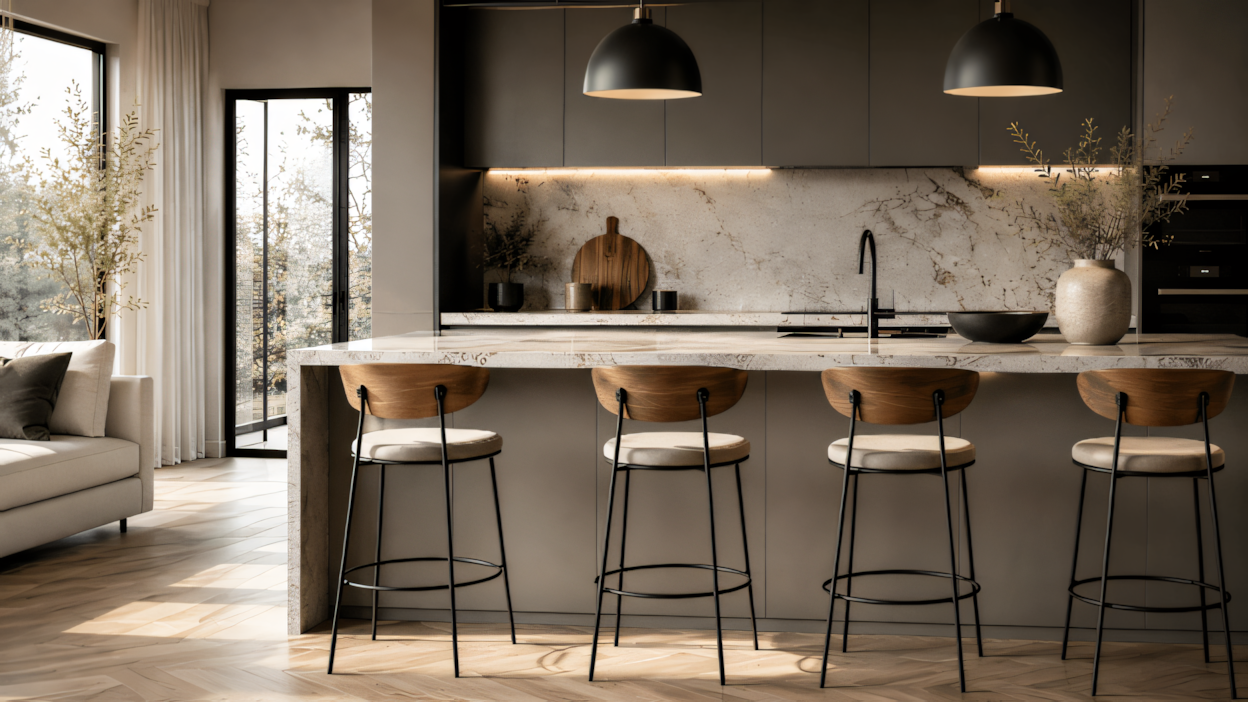
There's a strange idea floating around that small kitchens and good seating just don't go together. If your counter or breakfast bar is on the smaller side, you're stuck choosing between cramming in stools that don't fit properly or skipping seating altogether.
That's just not true.
Counter stools are actually one of the smartest solutions for a small UK apartment kitchen, not a compromise. The right stool takes up a fraction of the floor space a dining chair needs, tucks away when you're not using it, and still gives you somewhere to sit for a quick breakfast or a glass of wine while dinner's on.
The trick is choosing stools that suit a compact space, not ones built for a sprawling American-style kitchen island. Get the height, footprint, and style right, and a couple of well-chosen stools can make a small kitchen feel more finished, not more crowded.
Here are 12 ideas to help you get there.
Counter Height vs Bar Height - Getting the Sizing Right for Small Spaces
Before you fall in love with a particular stool, sort out the height. This matters more in a small kitchen than almost anywhere else, because there's no spare room to compensate if you get it wrong.
Most UK kitchen counters and islands sit at around 90cm. For that height, you want a counter stool with a seat height of roughly 60–65cm. Bar height is a different measurement entirely, closer to 105–110cm, which is for a raised breakfast bar rather than a standard worktop.
A lot of people get caught out by US sizing guides, since American counters and bar tops tend to sit higher than UK ones. If you buy a “bar stool” without checking, you can end up with something too tall for your worktop, which looks odd and is awkward to actually sit at.
As a simple rule: measure your counter height, subtract around 25–30cm, and that's the seat height you're after. When you're shopping, it's worth checking the seat height on every listing rather than going off the product name alone, since “bar stool” and “counter stool” get used loosely.
12 Counter Stool Ideas for Small Apartments
1. Go Backless for a Smaller Footprint

If floor space is genuinely tight, backless stools are the easiest win. Without a backrest, the stool itself is smaller, lighter to move around, and visually takes up less room - which matters a lot in a kitchen where every bit of breathing space counts.
They're also easier to slide fully under the counter overhang, so when you're not using them, they more or less disappear.
The Bontempi Eva Low Barstool (£255) is a good example. It's slim-legged and low-profile, which is exactly the kind of stool that doesn't visually crowd a small island or breakfast bar.
2. Choose a Low Backrest for Comfort Without Bulk

If you'd rather not go fully backless - fair enough, a bit of back support makes a quick breakfast or longer chat far more comfortable - look for a low backrest rather than a tall one.
A low back gives you something to lean into without adding much visual height or bulk to the stool. It keeps sightlines open across the kitchen, which is exactly what you want in a smaller room.
The Cattelan Italia Alessio Stool (£385, reduced from £450) has a simple, low silhouette that does this well - comfortable enough to sit at for a while, without dominating the counter.
3. Pick Stackable Stools If Storage Is Limited
Small apartments rarely come with spare storage, so if you need extra seating now and then but don't want stools cluttering the kitchen day to day, stackable designs are worth a look.
They stack neatly in a corner, a cupboard, or even under a console table, and come out when you actually need the extra seats - dinner with friends, a weekend visitor, whatever it is.
This is less about a single hero product and more a feature to check for when you're comparing stools: look for lightweight frames and a shape that nests cleanly with itself.
4. Choose Stools That Tuck Fully Under the Counter

This sounds obvious, but it's the detail people forget to check before buying. If a stool's seat or frame is too wide, it won't tuck under your counter overhang, and you'll be left with stools sticking out into the walkway permanently.
Measure your counter overhang before you buy, and compare it against the stool's width at its widest point - usually the seat, not the base. A few centimetres makes a real difference in a tight kitchen.
Slimmer designs like the Cattelan Italia Pepe Stool (£315, reduced from £370) tend to tuck away neatly thanks to a narrow steel frame and compact seat, which is exactly what you want when the stool needs to vanish between uses.
5. Go for Swivel Stools in Tight Galley Kitchens
Galley kitchens - the narrow, two-wall layout common in a lot of UK flats - don't leave much room to pull a stool out, sit down, and push it back in comfortably. A swivel base solves a lot of that friction.
Instead of needing to shuffle the whole stool backwards to get up, you simply turn and step off. It's a small thing, but in a galley kitchen where space behind the stool is minimal, it makes the seating far more practical day to day.
When you're shopping, check that the swivel mechanism is smooth and doesn't add height to the stool, since some swivel bases sit higher than fixed ones.
6. Add Footrests for Comfort on Narrow Breakfast Bars

A narrow breakfast bar usually means your feet are left dangling, which gets uncomfortable fast if you're sitting for more than a few minutes. A built-in footrest solves this without adding much to the stool's overall footprint.
The Cattelan Italia Pancho Steel Stool and Footrests (£820, reduced from £960) is built specifically with this in mind - a slim steel frame paired with a proper footrest, so you get genuine comfort without the bulk of a heavier, more traditional stool.
7. Bring in a Wood-Framed Stool for Warmth

Small kitchens can sometimes feel a bit cold or clinical, especially with a lot of steel, glass, and gloss finishes around. A wood-framed stool softens that instantly, without taking up any more room than a metal-framed equivalent.
The Cattelan Italia Dumbo Wooden Frame Stool (£1,055, reduced from £1,240) is a lovely option here - the natural wood frame adds warmth and texture to a compact kitchen, and it pairs nicely with both modern and more traditional cabinetry.
8. Choose Upholstered “Couture” Stools for a Softer Look

If your kitchen leans a little more elegant than utilitarian, an upholstered stool can do a lot for the room's overall feel without needing extra floor space. The fabric or leather seat softens the hard lines of worktops and cabinetry.
The Cattelan Italia Norma Couture Stool (£545, reduced from £640) is a good example of this done well - a compact, upholstered seat that feels considered rather than oversized, so it doesn't visually bulk up a small island the way a heavier upholstered chair might.
9. Try Steel-Frame Stools for a Lighter Visual Footprint
Even when a stool's actual dimensions are small, a chunky frame can still make it feel heavy in the room. Thin steel frames get around this - they hold weight perfectly well, but visually take up almost no space, which helps a small kitchen feel less cluttered.
Steel-framed options like the Cattelan Italia Pepe Stool are worth a look if you want seating that's sturdy but doesn't read as a large piece of furniture in the room.
10. Use Low Stools If Your Island Has Under 90cm of Clearance
Not every small kitchen island has the recommended 90–100cm of clearance around it. If yours is tighter than that, a lower stool that sits closer to the counter, with a smaller overall footprint, is the safer choice.
Lower stools generally have a smaller base too, which means less for people to bump into when they're moving through a tight kitchen. It's a small adjustment, but it changes how liveable the space feels day to day.
11. Mix Stool Heights for a Multi-Use Counter
If your counter does double duty - prep space at one end, casual seating at the other - it's worth having stools at slightly different heights to match. A taller stool works at a raised bar section, while a lower one suits a standard worktop height nearby.
This isn't about clashing styles. Stick to one finish or material family across the stools, and just vary the height to match what each section of the counter is actually doing.
12. Stick to Neutral or Monochrome Tones
Colour and pattern have their place, but in a small kitchen, a busy or brightly coloured stool can become the one thing your eye keeps catching - and not always in a good way.
Neutral tones - black, white, natural wood, soft grey - let the stool sit quietly in the room rather than competing for attention. It's a simple choice, but it's one of the easiest ways to keep a small kitchen feeling calm rather than busy.
Also read - 15 Square Kitchen Ideas That Make the Most of Your Space
Common Counter Stool Mistakes in Small Apartments
A few small missteps tend to crop up again and again when people are choosing stools for a compact kitchen. Worth checking these off before you buy.
-
Buying oversized stools - a stool that would look perfectly fine in a large kitchen can dominate a small one. Always check seat width and overall footprint, not just style.
-
Getting the height wrong - a stool that's too tall or too short for your counter is uncomfortable every single time you use it. Measure first.
-
Buying too many - it's tempting to fill every available gap along the counter, but in a small kitchen, two well-chosen stools usually work better than four crammed-in ones.
-
Ignoring walkway clearance - leave at least 75–90cm behind a seated stool so people can still move through the kitchen comfortably.
-
Choosing bulky frames - a heavy base or thick legs can make a stool feel like a much bigger piece of furniture than it actually is. Slimmer frames almost always work better in a compact space.
Over to You
A small kitchen doesn't mean settling for awkward seating or none at all. The right counter stools - sized properly, slim in profile, and chosen with your specific counter in mind - can make a compact UK kitchen feel just as finished and comfortable as a much larger one.
If you'd like to see the full range, browse our stools collection, including Cattelan Italia's bar stools and the wider kitchen and dining furniture range. Brands like Bontempi Casa and Cattelan Italia both do a lovely job of making small-space seating feel like a proper design choice, not a compromise.
FAQs
What height counter stool do I need for a UK kitchen counter?
Most UK kitchen counters sit at around 90cm, so you'll want a stool with a seat height of roughly 60–65cm. This is different from US-style bar height, which tends to suit a raised breakfast bar of around 105–110cm rather than a standard worktop. Always check the seat height listed on a product rather than assuming from the name - “bar stool” and “counter stool” are often used loosely.
How much space should I leave around a counter stool in a small kitchen?
Aim for at least 75–90cm of clearance behind a seated stool, so there's enough room for someone to walk past comfortably. If you're fitting stools around an island rather than a single counter, 90–100cm of clearance on each side is the general guide, though a slimmer or lower stool can work with a little less.
Are backless or backed stools better for small apartments?
Backless stools generally suit small apartments best, since they have a smaller footprint, tuck under the counter more easily, and don't add visual bulk to the room. That said, a stool with a low backrest can be a good middle ground if you want a bit more comfort for longer sitting, without the bulk of a full-back chair.